TL;DR: One in three high schools has no full-time athletic trainer, and the operational, financial, and safety consequences of that gap are real and measurable. This post lays out what athletic directors and program leaders are actually risking when AT coverage is inconsistent, and what a scalable solution looks like.
One in three high schools in the United States operates without full-time athletic training coverage. That number has been cited in research, echoed in policy discussions, and acknowledged in athletic director conversations for years. But acknowledging a statistic is not the same as understanding what it costs.
The athletic training coverage gap is not just a staffing inconvenience. It is a compounding program risk that shows up in injury outcomes, return-to-play decisions, parent trust, staff burnout, and ultimately in the operational stability of the entire athletic program.
The recent growth in youth sports participation has widened the gap further. More athletes are competing, overuse injuries have doubled since 2014, and the workforce of credentialed athletic trainers available to fill secondary school positions is not growing fast enough to meet demand. For athletic directors managing programs under budget pressure, this is not a future problem to plan for. It is a present one that needs a practical answer. Reviewing youth sports participation growth and the rising injury rate data every program leader should know puts that pressure in concrete terms.
Where the Data Stands on AT Access in Secondary Schools
The ATLAS study, the most comprehensive assessment of athletic trainer services ever conducted across U.S. secondary schools, found that 34% of the 20,272 schools reviewed had no access to athletic training services of any kind. Of the schools that did have access, nearly half were covered by part-time services only. The national picture is uneven by state, with some states reporting that more than 60% of their high schools lack AT coverage entirely.
This is not a fringe problem. It is the baseline operating condition for a substantial portion of athletic programs across the country, and the schools without coverage are not outliers. Many of them are managing full varsity rosters, multi-sport seasons, and competitive schedules with no licensed professional on the sideline and no structured plan for when an athlete gets hurt.
The Staffing Shortage Is Not Getting Better on Its Own
A 2024 NATA survey of secondary school athletic trainers found that approximately 25% of respondents planned to leave the secondary school setting, with roughly 28% considering leaving the profession entirely. Compensation disparities, workload pressure, and lack of institutional support were the most commonly cited reasons.
Programs waiting for the hiring market to self-correct are waiting for something that may not arrive. The pipeline is not growing fast enough to replace the professionals exiting the field, and the schools that are hardest to staff, rural districts, lower-funded programs, and multi-sport environments with a single AT position, are the ones feeling that most acutely.
What Actually Happens When Coverage Is Inconsistent
Injury Recognition Gets Delayed
Without an AT available at practices and events, the responsibility for recognizing and responding to injuries falls to coaches, volunteers, or athletes themselves. Research from the University of South Carolina found that 79% of catastrophic sports injuries and fatalities occur in high school athletes, and schools without dedicated AT access are significantly less likely to have the protocols in place to identify and respond to emergencies appropriately.
The problem is not that coaches lack effort or care. It is that injury recognition, triage, and management require clinical training that coaches are not required to have and, in most cases, do not possess. When the person making that call is doing their best without that background, the margin for error widens considerably.
Return-to-Play Decisions Become Guesswork
Return-to-play is one of the most consequential decisions in sports medicine. Without a licensed AT guiding that process, programs rely on informal timelines, physician clearance without sport-specific context, or, in the worst cases, athlete self-reporting. The risk of premature return, re-injury, and worsening outcomes is directly tied to the quality of the process behind the clearance decision.
Seeing what this coverage gap looks like in practice for high school baseball and cheer programs illustrates why structured return-to-play protocols matter and what it looks like when they are actually in place.
The Financial Cost Adds Up Faster Than Most Programs Expect
Emergency department visits for youth sports injuries now average $439 per visit, and inpatient care can exceed $6,000. Nationally, sports injuries cost an estimated $33 billion annually. For individual programs, the financial exposure is not theoretical.
Each unmanaged injury that escalates to emergency care, each re-injury from premature return-to-play, and each parent complaint that escalates to a liability claim represents a cost that is almost always greater than what proactive AT access would have required. The economics of prevention versus crisis response are not close.
On-Site AT Burnout Is a Program Risk, Not Just a Personnel Issue
For schools fortunate enough to have an AT on staff, the current conditions in secondary school athletic training create a different kind of coverage risk. When one AT covers multiple schools or sports simultaneously, the workload becomes unsustainable in ways that do not stay invisible for long.
The 2024 NATA survey found a direct relationship between emotional exhaustion in secondary school ATs and the likelihood of medical errors. An overloaded AT is not the same as adequate coverage. Programs that treat a single stretched position as a solved problem are underestimating the fragility of that arrangement.
The Framing Most Athletic Directors Have Not Used Yet
Most conversations about the athletic trainer shortage focus on hiring. The harder conversation is about program design.
If your coverage model depends entirely on whether one person shows up, accepts the job, and stays beyond two years, you do not have a coverage strategy. You have a staffing dependency that fails whenever that person is unavailable, overwhelmed, or gone. The programs that are managing this problem most effectively are the ones that have stopped designing around a single position and started building models that do not collapse when that position goes unfilled.
That is a different question than “when can we hire someone?” It is a structural question about how athlete care is delivered across your entire program, not just during the hours when one staff member happens to be present.
What a Scalable Coverage Model Actually Looks Like
Scalable AT coverage does not mean replacing your on-site staff. It means building a model that functions in the hours, locations, and situations where on-site staff cannot be present.
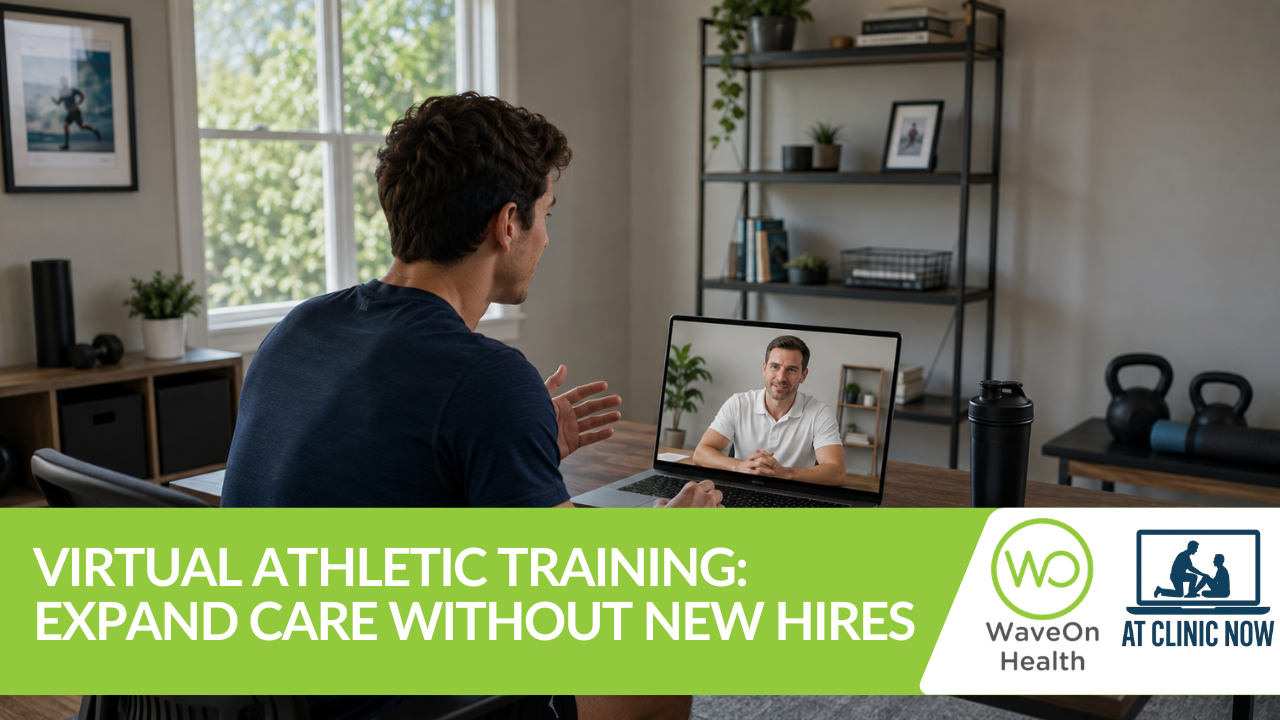
Virtual athletic trainer access for schools without coverage, structured through a platform like WaveOnConnect, covers the early evening practice where no AT is scheduled. It handles the athlete who needs follow-up on a mild sprain from last Tuesday. It gives the solo AT at your school a virtual assistant athletic trainer layer so they can work at the top of their license instead of spreading themselves across every concern that walks through the training room door.
For programs without a full-time AT, this is the difference between no care and structured care. For programs with a part-time or stretched AT, it is the difference between covering events and covering athletes. To learn how WaveOn Health expands AT capacity for schools and sports organizations, their approach addresses each of these scenarios with solutions that scale to the program, not the other way around.
Frequently Asked Questions
What percentage of U.S. high schools have no athletic trainer?
The Korey Stringer Institute’s ATLAS study found that 34% of secondary schools have no access to athletic training services of any kind. Among the schools that do have access, nearly half receive only part-time coverage. The distribution is uneven by state, with rural and lower-funded districts reporting the highest rates of no coverage.
What is the liability exposure for schools without AT coverage?
While liability varies by state and circumstance, schools without documented AT protocols for injury recognition, management, and return-to-play face greater exposure when injuries escalate or return-to-play decisions result in re-injury. Having a structured, documented care process is one of the clearest ways to demonstrate appropriate duty of care. The absence of that documentation is a gap that becomes visible quickly in adverse situations.
Can virtual athletic training work for high-risk contact sports?
Virtual AT access is most effective for initial evaluation, ongoing communication, personalized exercise programming, and return-to-play guidance. For high-risk contact sports and final clearance decisions, physical presence remains the standard. Virtual and hybrid models are designed to supplement and extend coverage, not replace on-site clinical judgment in high-acuity situations.
How much does it cost to add virtual AT coverage to an existing program?
Virtual and hybrid AT models are significantly more cost-effective than adding a full-time staff position. The exact structure depends on program size and coverage needs. WaveOn Health offers a demo to help program leaders understand what coverage would look like for their specific situation before committing to any arrangement.
How does the athletic trainer shortage affect rural schools specifically?
Rural schools are three to four times more likely to lack AT coverage compared to suburban schools, according to NATA research. Geographic access barriers make in-person hiring especially difficult for these programs, which is precisely where virtual athletic training platforms provide the most meaningful and immediate impact on athlete safety.
How do athletic directors handle AT coverage gaps on a limited budget?
The most practical approach is building a hybrid coverage model that uses a virtual platform to cover the hours and settings where on-site AT staff cannot be present. This extends the value of whatever coverage already exists rather than requiring a full additional hire, and it creates a documented care structure that operates consistently regardless of who is physically on site.
The Programs That Get Ahead of This Problem Have One Thing in Common
They stopped treating the athletic training coverage gap as a staffing problem and started treating it as a program design problem. That shift changes the question from “when can we hire someone?” to “how do we build a coverage model that works even when hiring is difficult?”
That is a question WaveOn Health is built to answer. If you are an athletic director, school administrator, or sports organization leader who knows your current coverage model has gaps, the next step is a conversation about what a scalable alternative looks like for your program. Learn how WaveOn Health expands AT capacity for schools and sports organizations at every coverage level, then book a call to explore what scalable coverage could look like for your program and see exactly what expanded AT access would mean for your athletes this season.